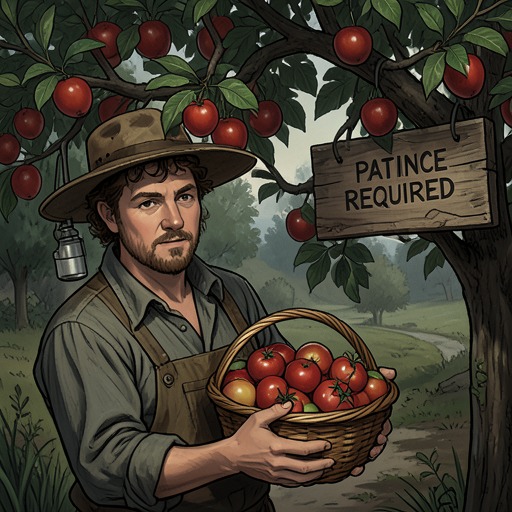
Dig It and Forget It
Crazy Mama: 9 Steps to a Not-So-Normal LifeDig It and Forget It is the book’s second rule for sowing and reaping: once a good seed has been planted, faith requires leaving its hidden growth in God’s hands rather than digging it up to check for progress. The expression turns gardening into a model for prayer, generosity, and patient trust. Its decisive point is not passivity, but a distinction between what a person can tend and what cannot be controlled: commitment continues above the soil while the timing and source of increase remain unseen.
The Rule and Its Gardening Image
The rule appears after a discussion of sowing seeds of kindness, love, mercy, forgiveness, joy, and faith without imposing a time limit on the harvest. Dig It and Forget It names the next challenge: people may do the work of planting and then undermine their own patience by trying to inspect the seed before it has had time to grow. The temptation is presented as familiar, a way of wanting immediate proof that an unseen process is working.
A homeschooling project gives that temptation a vivid counterexample. The children planted bean seeds in a clear glass jar lined with a wet paper towel. Because the jar was transparent, the family could watch the seed swell and split, then see roots and shoots emerge and divide. That visible sequence was exciting, but the author contrasts it with ordinary gardening, where soil conceals what is happening. The difference matters: the jar makes growth observable, while the dark soil makes it a matter of trust.
The metaphor does not tell readers to neglect what they have planted. It changes what counts as responsible care. The seed must be planted and covered, but its development cannot be forced into view without disturbing it. The title’s paired commands therefore hold together an action and a restraint: do the planting, then refrain from treating constant inspection as proof of faithfulness.
The Parable and Unseen Growth
The rule is grounded in a parable from Mark in which a man scatters seed, sleeps and rises night after night, and watches the crop develop without knowing how. The growth proceeds in stages: first the blade, then the ear, and finally the full grain in the ear. The phrase “he knows not how” becomes the passage’s hinge. It shifts attention away from the planter’s ability to explain the process and toward the fact that growth can continue beyond his knowledge.
The author makes this uncertainty the point rather than a gap to be filled. People may want to understand exactly how God will produce a breakthrough, or to narrow the possible answer to a list of outcomes they can imagine. The teaching rejects that attempt to fit divine action inside human foresight. God may work through unexpected people, open doors that were not anticipated, or develop abilities the person did not know were possible; the result, the author says, can exceed what was expected.
This reasoning connects the seed image to the book’s wider account of blessing. Elsewhere, blessing is described as an inheritance established in God’s Word, and the reader is urged to claim what has been promised rather than settle for little dreams. The seed rule supplies a temporal discipline for that confidence: an inheritance may be understood as promised, but its effects need not appear immediately or arrive by a route the recipient can predict.
Patience in Prayer and Giving
The examples make the rule concrete in two areas where delay can feel like evidence of failure. Someone praying habitually for another person may see that person appear to get worse instead of changing. Someone giving financially, including through tithing, may still face a stack of bills and an income that is not growing. In both cases, the visible circumstances seem to contradict the purpose of the seed. The teaching acknowledges the frustration of staring at apparently unchanged ground, but argues that visible evidence does not disclose what is happening beneath it.
That claim depends on faith in a process whose mechanism remains hidden. The instruction is not to prescribe the miracle or to make a timetable for it, but to maintain trust while the outcome is unavailable to sight. The seed must establish roots before sending up shoots; growth that appears too quickly without a firm foundation would not provide the same basis for a lasting breakthrough. Delay is therefore interpreted not simply as absence, but as a possible period of root-building whose activity cannot yet be observed.
Continued Care Without Control
Forgetting the seed does not mean abandoning the ground. The rule assigns ongoing responsibility to commitment: the seed is watered through persistence and the ground weeded through righteousness. The author warns against letting sin create doubt and compares jealousy of another person’s harvest to salt poured into the soil. The positive alternatives are relational as well as devotional: love others, pray for them, bless them, and keep sowing rather than measuring one’s progress against someone else’s visible results.
The rule’s memorable summary is to “sow and sleep”: sowing belongs to the person, while God is responsible for the increase. Sleep figures as the counterpart to anxious inspection, not as a substitute for planting or care. The final distinction is between continuing faithful action and surrendering control over the timing and method of its return. In that sense, Dig It and Forget It converts the book’s broad promise of abundance into a practice of patience: plant, tend, resist envy and doubt, and leave unseen growth unseen until its season.